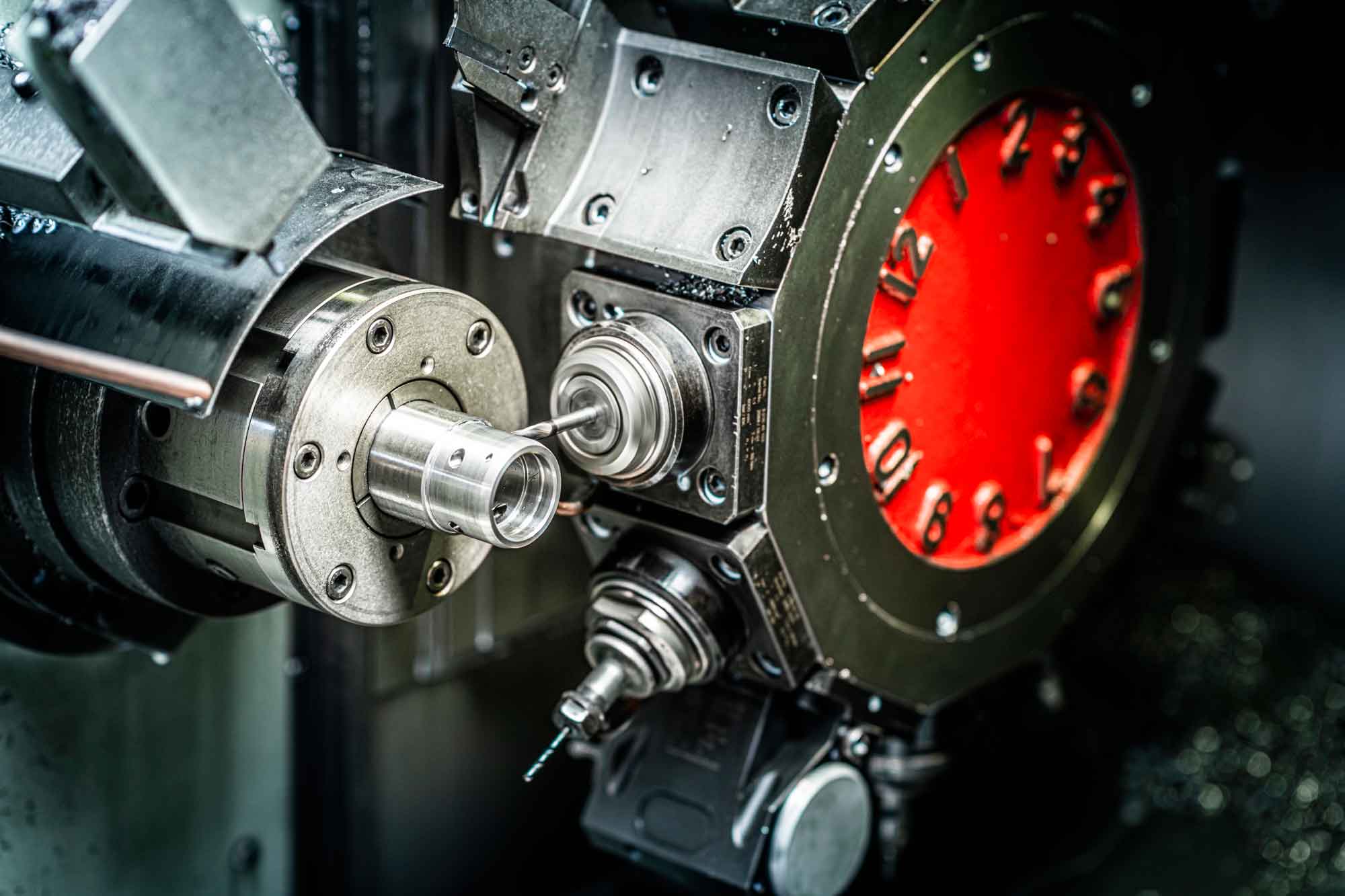
CNC Turning for Reliable Mass Production
FROM 10 TO 10,000 UNITS
You’re looking for CNC turning that’s not only precise on the first delivery, but also on every subsequent batch. By paying close attention to critical diameters, fits, and the tolerances specified in your drawing, Brans ensures a meticulously prepared turning process. This way, you can count on reproducible components and reliable execution of your series production.

Contributing Ideas on Social Engineering
A technical drawing serves as the starting point. We assess how your component can be efficiently mass-produced according to the specifications.

Accuracy to 0.01 mm
For components that require precise dimensions. Depending on the material, geometry, and machining process.

Ready for repeat orders
Recorded processing data helps ensure that the same production approach is used for the next order.

CNC metal turning: Ø4 to Ø250 mm
CNC turning tailored to your component
For turned components with critical diameters or fits, you want to know in advance whether the requested dimensions are feasible—especially when you regularly order the same component in batches. Brans manufactures CNC-turned parts ranging from Ø4 to Ø250 mm in quantities from 10 to 10,000 pieces.
We tailor the turning process to the geometry, material, and tolerances specified in your technical drawing. Whether it involves components for machines, devices, or transportation systems, the chosen production approach must align with the component’s function and the desired quantities. This gives you clarity upfront regarding the manufacturability and execution of your production run.
A Consistent Approach for Recurring Series
CNC Turning with a Focus on Reproducibility
When it comes to recurring turning work, you don’t want to be dependent on how a previous batch happened to be produced. The dimensions and quality must meet the same specifications for subsequent orders as well. That’s why we pay close attention to preparation, setup, and documenting the chosen machining method. This provides a solid foundation for repeat orders. The previous production approach remains available and serves as the basis for a carefully prepared subsequent batch.

Providing technical input before production begins
From technical design to manufacturable CNC-machined parts
Different diameters, contours, bores, and precise fits can impose specific requirements on the execution of your turning work. When evaluating your drawing or 3D model, we examine the geometry, clamping, machinability, and specified tolerances. This is relevant, for example, for components in mechanical engineering, medical equipment, or packaging machines, where the dimensions must align with the component’s function within a larger system.
Does a particular size or machining operation require extra attention? If so, we’ll investigate how it can be manufactured according to specifications and discuss the options with you in advance. This ensures that any technical considerations are clarified before production begins, without compromising the functional requirements of your component.
The material and dimensions determine the machining process
CNC Turning of Aluminum, Stainless Steel, and Other Materials
The material for your component is often already specified. In that case, you’ll want to know how its properties affect manufacturability, dimensional accuracy, and series production. When CNC turning metal, we tailor the tools, cutting conditions, and machining sequence to the selected material.
Brans machines materials such as aluminum, stainless steel, and steel. Plastics and non-ferrous metals such as copper, brass, and bronze can also be machined. For an aluminum component, weight can be an important design requirement, while for stainless steel, for example, corrosion resistance or cleanability plays a role. We therefore always evaluate the material in conjunction with the geometry and tolerances specified in your drawing. This ensures that the machining process meets the requirements of your component.

Critical diameters under control
Precision CNC turning with dimensional control
When a machined component needs to fit or move within an assembly, its dimensions determine how it functions. That is why we focus our quality control on the critical dimensions and tolerances specified in your drawing. Depending on the measurement task, we use tools such as micrometers and CNC 3D measuring machines. This is particularly important for components used in precision systems, laboratory equipment, and moving machine structures.
Brans is ISO 9001 certified. Established procedures and agreed-upon inspections ensure consistent execution of the production process.
Precision According to Your Specifications
With suitable components, Brans can achieve an accuracy of up to 0.01 mm. Whether that level of accuracy is achievable depends on factors such as the material, the geometry, and the chosen machining process.
The tolerances specified in your drawing always take precedence. We assess in advance how these can be achieved and verified. This way, you’ll know which production approach is needed to achieve the required dimensions.
Building on previously produced turned parts
Consistent quality for repeat orders
When placing a repeat order, you want to be able to rely on the same dimensions and quality as in the previous production run. That is why Brans records relevant production data in tooling and machining lists. These lists include, among other things, the clamping methods, tools, and measuring equipment used.
This information will be available again for your next order. We can build on the previous production approach without having to re-determine how the component was manufactured. This helps us carefully prepare subsequent production runs and maintain consistent quality across different production runs.

Combine multiple operations whenever possible
Combining CNC Turning and Milling
Does your turned part also require drilling, slotting, or other milling operations? If so, it may be cost-effective to combine different machining operations.
With multitasking machines, we can perform certain turning and milling operations in a single setup. This can reduce the number of setups and helps maintain dimensional consistency between operations. We evaluate each component to determine whether this production method is suitable for its geometry and the desired production run.
Include the desired finish in the planning
Post-processing of CNC-machined turned parts
Does your turned component need to be anodized, nickel-plated, or galvanized after machining? If so, you’ll want to ensure that the post-processing aligns with the technical requirements and production schedule.
Upon consultation, we can incorporate these processes into the production workflow. In doing so, we take into account the material and the desired finish.
This ensures that the various production steps flow seamlessly into one another, so you don’t have to coordinate the post-processing separately.

From your drawing to a suitable production approach
Outsource CNC turning to Brans
Do you have an existing turned part that you’d like to have remanufactured, or a new design for mass production? Send us your technical drawing or 3D model, along with the desired quantities, material type, and relevant specifications.
We assess the feasibility, discuss any technical considerations, and prepare a quote based on an appropriate production approach.